





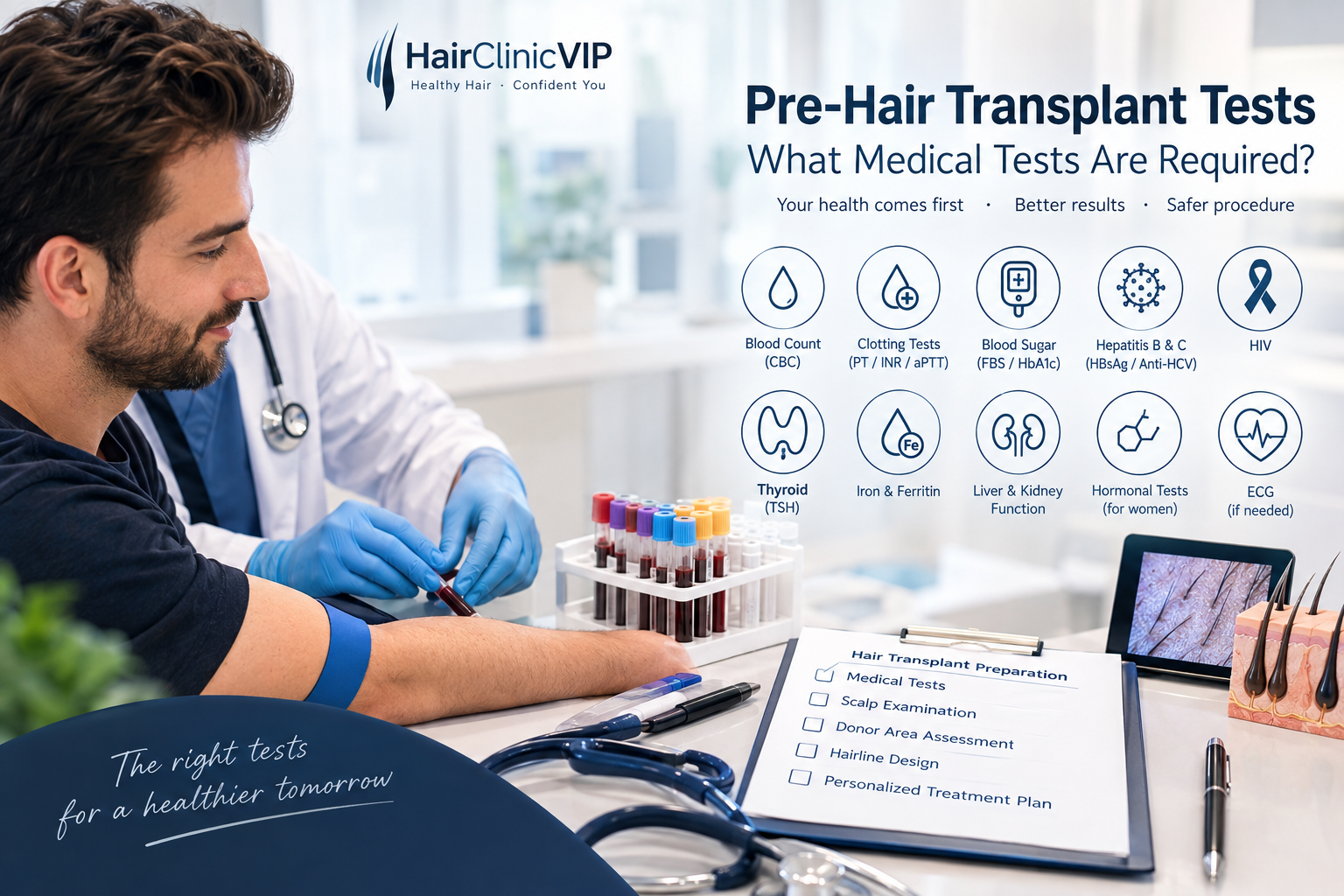
Pre-Hair Transplant Tests: What Medical Tests Are Required?
Why Are
Pre-Hair Transplant Tests Important?
The purpose
of medical testing before a hair transplant is not simply to determine whether
a patient can undergo the procedure.
Preoperative
evaluation can help identify conditions such as:
- Anemia
- Abnormal
platelet counts
- Blood-clotting
disorders
- Elevated
blood glucose
- Certain
infectious diseases
- Medical
conditions that may require additional evaluation
It is also
important to determine the cause of hair loss and confirm that the patient is
an appropriate candidate for hair transplantation.
Most Common
Pre-Hair Transplant Tests
The exact
tests depend on the patient's health status and the protocol used by the
physician or medical center.
1. CBC –
Complete Blood Count
A CBC
(Complete Blood Count) is one of the commonly considered blood tests before
a medical procedure.
It provides
information about:
- Hemoglobin
levels
- Red
blood cells
- White
blood cells
- Platelet
count
- Possible
anemia
Platelets
are particularly relevant because they play an important role in blood
clotting.
2. Blood
Clotting Tests: PT, INR and aPTT
The
physician may request blood-clotting tests such as:
- PT
- INR
- aPTT
These tests
help assess the blood-clotting system and may identify certain bleeding or
clotting abnormalities.
They can be
particularly relevant for patients with a history of abnormal bleeding or those
taking anticoagulant or antiplatelet medications.
3. Blood
Glucose Tests Before Hair Transplantation
Blood
glucose may also be evaluated before a hair transplant.
Depending
on the patient's medical history, the physician may request:
- FBS –
Fasting Blood Sugar
- HbA1c
– Hemoglobin A1c
Blood
glucose assessment is particularly important in people with diabetes, because
good glucose control is an important part of preoperative medical assessment.
However,
HbA1c is not necessarily required for every healthy person. The decision should
be based on the individual's medical history and risk factors.
4.
Hepatitis B and Hepatitis C Tests
Some
medical centers request infectious-disease screening before hair
transplantation.
These tests
may include:
- HBsAg for hepatitis
B
- Anti-HCV for hepatitis
C
These tests
can help determine the patient's health status and are also relevant to
infection-control protocols in medical facilities.
5. HIV Test
An HIV
test may be requested according to the medical center's protocol and the
patient's individual circumstances.
If a
patient has a known or suspected medical condition requiring additional
evaluation, the physician can take the appropriate precautions and plan care
accordingly.
6. Iron and
Ferritin Tests
Ferritin reflects the
body's iron stores.
Iron and
ferritin testing may be particularly useful in people who have:
- Diffuse
hair shedding
- A
history of anemia
- Possible
iron deficiency
- Dietary
factors that increase the risk of iron deficiency
It is
important to remember that hair transplantation does not treat every underlying
cause of hair loss. If hair loss is related to iron deficiency or another
medical condition, the underlying cause should be evaluated and treated when
appropriate.
7. Thyroid
Testing: TSH
Thyroid
disorders can be associated with hair loss.
For this
reason, the physician may consider TSH or other thyroid tests when:
- The
patient has a history of thyroid disease
- Symptoms
suggest a thyroid disorder
- Hair
loss has an unusual pattern
- There
is a clinical suspicion of an underlying medical cause
Thyroid
testing is not automatically necessary for every person considering a hair
transplant.
8. Hormonal
Tests for Women
Some women
with an unusual pattern of hair loss may require hormonal evaluation.
Depending
on symptoms and the medical assessment, tests may include:
- Total
testosterone
- Free
testosterone
- DHEA-S
- Other
hormone tests when clinically indicated
Hormonal
testing may be more relevant when symptoms such as irregular menstrual cycles,
increased facial or body hair, or other signs of hormonal imbalance are
present.
Therefore,
routine hormonal testing is not necessarily required for every woman undergoing
a hair transplant.
9. Liver
and Kidney Function Tests
Additional
tests may sometimes be requested, including:
- AST
- ALT
- Creatinine
- BUN
These tests
may be more relevant for people with:
- Kidney
disease
- Liver
disease
- Diabetes
- Certain
medication use
- Medical
conditions or risk factors requiring additional evaluation
Is an ECG
Necessary Before a Hair Transplant?
Not
necessarily for every patient.
An ECG
(electrocardiogram) may be considered for people with:
- A history
of heart disease
- Cardiovascular
symptoms
- Certain
cardiac risk factors
- Specific
chronic medical conditions
- Or
when recommended by the physician
Some
clinics may include an ECG in their standard preoperative protocol. However,
the need for an ECG should ultimately be determined according to the patient's
health status and medical evaluation.
Do You Need
to Fast Before Hair Transplant Tests?
It depends
on the tests being performed.
If your
physician has requested a test that requires fasting, such as FBS, you
should follow the laboratory's fasting instructions.
Not every
pre-hair transplant test requires fasting.
For this
reason, confirm the preparation instructions with the laboratory before having
your blood drawn.
Are Hair
Transplant Tests Different for Men and Women?
Many of the
general medical tests may be similar for men and women. However, additional
testing can differ depending on the patient's symptoms and medical history.
For
example, some women with an unusual pattern of hair loss may require evaluation
for iron deficiency, thyroid disorders, or hormonal abnormalities.
For men
with a clear pattern of androgenetic alopecia, the evaluation may focus more on
overall medical health, accurate diagnosis of hair loss, and assessment of the
donor area.
Trichoscopy
Before Hair Transplantation
Trichoscopy is an important
examination that can be used to evaluate the scalp and hair before transplantation.
It can help
the physician:
- Identify
the type of hair loss
- Assess
hair density in the donor area
- Evaluate
hair shaft thickness
- Examine
follicular structures
- Identify
certain scalp disorders that can resemble genetic hair loss
- Plan
the number and distribution of grafts
For this
reason, a detailed scalp and hair assessment can be just as important as blood
testing when planning a hair transplant.
Why Is
Donor Area Assessment Important?
During a
hair transplant, follicles are taken from the donor area and
transplanted into areas affected by thinning or baldness.
Before the
procedure, the physician should evaluate:
- Donor
hair density
- Hair
shaft thickness
- The
number of potentially harvestable grafts
- The
stability of donor hair
- Whether
sufficient grafts can be harvested without unnecessarily depleting the
donor area
This
assessment helps the physician develop an appropriate transplantation plan.
What
Medications Should You Tell Your Hair Transplant Surgeon About?
Before your
procedure, tell your physician about all medications, supplements, and
herbal products you use.
In
particular, inform your physician if you take:
- Aspirin
- Warfarin
- Anticoagulant
medications
- Antiplatelet
medications
- Certain
NSAIDs
- Dietary
supplements
- Herbal
products
Some
medications and supplements can affect bleeding or blood clotting.
Never stop
a prescribed medication on your own.
Any medication
adjustment or discontinuation should only be made after consulting the
appropriate physician.
Pre-Hair
Transplant Test Checklist
The
potential tests can be summarized as follows:
Commonly
Considered Tests
- CBC
and platelet count
- PT /
INR
- aPTT
- Blood
glucose
- Infectious-disease
screening according to the clinic's protocol, such as HIV and hepatitis B
and C
Additional
Tests Depending on the Patient
- HbA1c
- Ferritin
- Iron
- TSH
- Liver
function tests
- Kidney
function tests
- Hormonal
testing in selected women
- ECG
when clinically indicated
There is no
single mandatory test list that applies to every patient. The appropriate tests
should be determined based on medical history and clinical assessment.
When Might
a Hair Transplant Be Postponed?
A physician
may recommend postponing the procedure if an important medical issue requires
further evaluation or treatment.
Examples
may include:
- Significant
anemia
- Important
clotting abnormalities
- Poorly
controlled blood glucose
- An
active or uncontrolled medical condition
- Active
scalp inflammation or skin disease
- Undiagnosed
hair loss
- An
unsuitable or inadequate donor area
In such
cases, the underlying issue should be addressed before making a final decision
about transplantation.
Are Blood
Tests Alone Enough Before a Hair Transplant?
No.
Blood
testing is only one part of the preoperative assessment.
A complete
evaluation may also include:
1.
Identifying the cause of hair loss
2.
Assessing the donor area
3.
Evaluating hair density and thickness
4.
Examining the scalp
5.
Reviewing medical history and medications
6.
Understanding the patient's expectations
7.
Designing the hairline
8.
Estimating the number of grafts required
For this
reason, a professional consultation and detailed scalp assessment are essential
steps in planning a personalized hair transplant.
Conclusion
Pre-hair
transplant tests help evaluate a patient's overall health and determine whether
appropriate preparation is needed before the procedure.
Commonly
considered tests may include CBC, platelet count, clotting tests, blood
glucose, and infectious-disease screening such as hepatitis and HIV testing.
Depending
on the individual's medical history and symptoms, additional tests such as Ferritin,
Iron, TSH, HbA1c, liver and kidney function tests, or hormonal tests may
also be appropriate.
In addition
to laboratory tests, trichoscopy and careful assessment of the donor area
play an important role in determining candidacy and planning the
transplantation procedure.
If you are
considering a hair transplant, the best approach is to have a medical
assessment first so that your physician can determine which tests are
appropriate for you and develop a treatment plan based on your individual
needs.
Frequently
Asked Questions
Does
everyone need blood tests before a hair transplant?
The
required tests vary from person to person. Some tests are commonly included in
hair transplant protocols, while others may only be appropriate for selected
patients.
Is a
thyroid test necessary before a hair transplant?
Not
necessarily. Thyroid testing may be recommended when there is a history of
thyroid disease, relevant symptoms, or an unusual pattern of hair loss.
Should
ferritin be tested before a hair transplant?
Ferritin
testing may be useful when iron deficiency, anemia, or diffuse hair shedding is
suspected.
Is an ECG
necessary before a hair transplant?
Not for
everyone. The need for an ECG depends on factors such as age, medical history,
symptoms, cardiovascular risk factors, and the physician's assessment.
Can a hair
transplant be performed without blood tests?
The
decision regarding which tests are needed should be made by the physician based
on the patient's medical history and overall health.
Request Consultation
There are many books written about the past, present, and future that require extensive knowledge from specialists to better understand the software.