





Hair Transplantation Over Scars: Is It Possible for Hair to Grow on Damaged Skin?
Does Hair
Naturally Grow Over Scar Tissue?
In many
cases, hair does not naturally grow over scar tissue. The main reason is damage
to or complete loss of hair follicles as a result of an accident, burn,
surgery, or deep wound.
When the
skin suffers a severe injury, the body creates new tissue to repair the damaged
area. This new tissue may differ from normal skin in terms of structure,
thickness, and blood supply.
In deep
scars, hair follicles may be completely destroyed. Therefore, expecting
spontaneous hair growth in such an area is generally not realistic.
However,
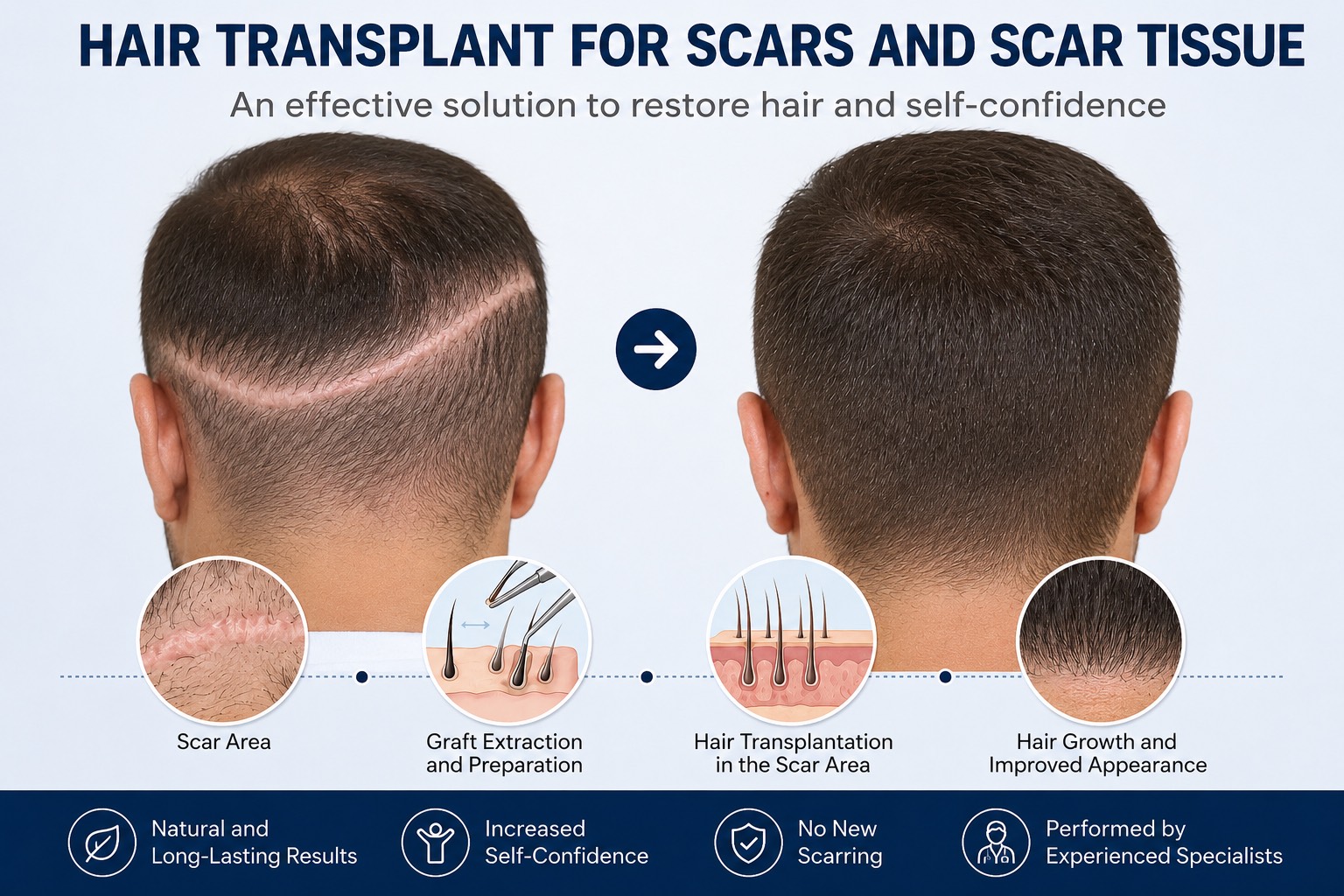
this does not mean that hair growth in the area is impossible. If the
conditions are suitable, healthy follicles can be harvested from the donor area
and transplanted into the scarred area.
How Is Hair
Transplantation Performed Over Scar Tissue?
Hair
transplantation over scars is a specialized procedure designed to transfer healthy hair
follicles to an area where natural hair has been lost.
During the
procedure, the condition of the skin and scar is first evaluated. If the area
is considered suitable, healthy follicles are extracted from the donor area and
carefully implanted into the target area.
However,
hair transplantation on scarred skin is different from transplantation on
healthy skin.
Scar tissue
may have:
- Different
blood supply.
- Greater
or lesser thickness than normal skin.
- Reduced
flexibility.
- A
harder, more fibrous structure.
For this
reason, hair transplantation in scar tissue requires careful evaluation and
appropriate planning. Scientific sources and specialized reviews also emphasize
that patient selection, scar characteristics, and blood supply are important
factors in the success of hair transplantation over scar tissue.
Is Hair
Transplantation Over Scars Really Successful?
In many
individuals, hair transplantation over scar tissue can significantly improve
the appearance of the affected area. However, results are not the same for
everyone.
One of the
most important factors is the blood supply to the scar tissue. Transplanted
follicles need oxygen and nutrients to survive and begin growing.
If the
blood supply to the area is adequate, the likelihood of transplanted follicle
survival increases.
For this
reason, it is not possible to provide a specific success rate for everyone
without examining and assessing the scar.
In many
cases, the realistic goal is to improve coverage and camouflage the scar rather
than completely eliminate it.
What Types
of Scars Can Be Treated With Hair Transplantation?
The type of
scar is one of the most important factors in determining whether hair
transplantation is possible.
1. Hair
Transplantation Over Stitch Scars
Some people
develop linear scars on the scalp following surgery or stitches.
If the
stitch scar has healed properly and the skin is stable, hair transplantation
may be an option for improving its appearance and providing better coverage.
2. Hair
Transplantation Over Burn Scars
Burns are
an important cause of scar formation and hair follicle loss.
Hair
transplantation over burn scars may be possible, but the severity of the burn
and the depth of the injury are particularly important.
Burn scars
can have different characteristics, so they should be evaluated in terms of
thickness, flexibility, and blood supply.
3. Hair
Transplantation Over Accident Scars
Injuries
caused by accidents, cuts, or trauma can damage hair follicles.
If the
wound has completely healed and the skin is stable, hair transplantation may be
considered as an option for improving the appearance of the affected area.
4. Hair
Transplantation Over Surgical Scars
Some
surgical procedures can leave scars on the scalp or in areas where hair
normally grows.
Depending
on the type and location of the scar and the condition of the tissue, hair
transplantation may be one of the available options for providing better
camouflage.
What Are
the Main Requirements for Hair Transplantation Over Scars?
Before
performing a hair transplant over scar tissue, the physician or specialist team
should evaluate several factors.
1. Scar
Stability
The scar
should be stable in terms of its condition and appearance.
Hair
transplantation may not be appropriate on a wound that is still actively
healing or is experiencing inflammation.
2. Adequate
Blood Supply
Adequate
blood supply plays an important role in the survival of transplanted hair
follicles.
Blood flow
in scar tissue may differ from that of healthy skin. Therefore, careful
evaluation of the area is important.
3.
Thickness and Type of Scar Tissue
Some scars
are very thin, while others are thick and raised.
Each of
these conditions can affect how the hair transplant is designed and performed.
4. Donor
Area Condition
The
availability of suitable hair follicles in the donor area is essential for hair
transplantation.
The quality
and density of the donor area can affect the number of grafts that can be
harvested and the final design of the procedure.
5. Cause of
the Scar
The cause
of the scar is also important.
Scars
caused by surgery, burns, or accidents may have different characteristics. In
addition, some types of scarring hair loss caused by inflammatory diseases
require specialized evaluation and confirmation that the condition is stable
before transplantation is considered.
What Is the
Best Hair Transplant Technique for Scar Tissue?
Many people
ask:
Is the FUE
technique suitable for hair transplantation over scars?
The
appropriate technique depends on the individual's condition.
During a
hair transplant, the method used to extract and implant follicles should be
selected based on factors such as:
- Donor
area condition.
- Type
of scar.
- Location
of the scar.
- Size
of the affected area.
- Skin
quality.
- Blood
supply.
Therefore,
one technique cannot be considered the best option for everyone without an
individual assessment.
In many
cases, the treatment plan should be fully personalized.
Why Is Hair
Transplantation on Scarred Skin More Sensitive?
Scarred
skin differs from normal skin.
In healthy
skin, the normal skin structure and blood vessel network provide suitable
conditions for hair follicle survival and growth.
However,
scar tissue may have:
- Reduced
or altered blood supply.
- Increased
fibrous tissue.
- Increased
skin stiffness.
- Reduced
flexibility.
- Altered
skin thickness.
These
factors mean that hair transplantation over scar tissue requires greater
precision.
For this
reason, the density of implantation and the number of grafts should be planned
according to the condition of the scar tissue.
Will
Transplanted Hair Grow on Scar Tissue?
If the
transplanted follicles are able to establish themselves properly in the new
area and the conditions necessary for their survival are available, hair growth
is possible.
However, it
is important to understand that scar tissue does not respond identically in
every individual.
Factors
such as:
- Quality
of blood supply.
- Type
of scar.
- Tissue
thickness.
- Surgical
technique.
- Post-operative
care.
can affect
the final outcome.
Therefore,
patients should not expect the results of transplantation on scar tissue to be
exactly the same as transplantation on healthy skin.
Is One
Session Enough for Hair Transplantation Over a Scar?
For some
individuals, one session may be sufficient to improve the appearance of the
scar.
In other
cases, a staged treatment plan may be considered to achieve adequate density
and coverage.
The number
of sessions depends on factors such as:
- Size
of the scar.
- Desired
density.
- Blood
supply.
- Donor
area quality.
- The
body's response to the initial transplant.
In some
cases, staged treatment may help protect the tissue and achieve a more
natural-looking result.
Will the
Scar Completely Disappear After Hair Transplantation?
It is
important to understand that hair transplantation is generally not intended
to physically remove the scar.
The primary
goal is to provide hair coverage and make the scar less visible.
The
transplanted hair can help camouflage the scar more effectively.
Therefore,
a realistic expectation is an improvement in the appearance of the area, rather
than complete disappearance of all signs of the scar.
Who Is a
Suitable Candidate for Hair Transplantation Over a Scar?
People with
the following conditions may be candidates for evaluation:
✓ The scar has completely healed.
✓ The scar is stable.
✓ There is no active inflammation or infection.
✓ The donor area has suitable quality.
✓ The blood supply to the area is considered
adequate for transplantation.
✓ The individual has realistic expectations about
the outcome.
The final
decision should be made after a professional evaluation.
Who Needs
Further Evaluation Before Hair Transplantation?
Some
conditions require more detailed assessment, including:
- Very
thick or raised scars.
- Extensive
scars.
- A
history of keloid formation.
- Active
scalp diseases.
- Scarring
hair loss caused by inflammatory conditions.
- Possible
problems with blood supply to the skin.
In these
situations, additional evaluation or treatment may be required before making a
decision about hair transplantation.
Aftercare
Following Hair Transplantation Over a Scar
Proper
aftercare plays an important role in the healing process.
Common
aftercare instructions may include:
- Avoid
touching or manipulating the grafts.
- Follow
the recommended hair-washing instructions.
- Take
prescribed medications according to the physician's instructions.
- Avoid
trauma or impact to the transplanted area.
- Attend
scheduled follow-up appointments.
Post-operative
instructions may vary from person to person.
Therefore,
the instructions provided by the treating physician and medical team should
always take priority.
Benefits of
Hair Transplantation Over Scars
For
suitable candidates, hair transplantation over scar tissue can offer several
benefits.
Improved
Appearance of the Scar
Hair growth
around or within the scar can make it less noticeable.
Increased
Self-Confidence
A scar on
the scalp or along the hairline can be bothersome for some people.
Improved
hair coverage may have a positive effect on appearance and self-confidence.
Use of the
Patient's Own Hair
When
appropriate, the follicles used for transplantation are generally taken from
the patient's own donor area.
Is Hair
Transplantation Over a Scar Painful?
The level
of pain or discomfort depends on the individual, the technique used, and the
type of anesthesia.
Many hair
transplantation procedures are performed under local anesthesia.
Some
temporary sensitivity or discomfort may occur after the procedure.
Medical
instructions and prescribed medications can help manage these symptoms.
How Much
Does Hair Transplantation Over a Scar Cost?
The cost of
hair transplantation over a scar depends on several factors, including:
- Size
of the scar.
- Number
of grafts required.
- Type
and condition of the scar.
- Technique
selected.
- Condition
of the donor area.
- Complexity
of the procedure.
For this
reason, an exact price usually cannot be determined without evaluating the
individual's condition.
Conclusion:
Is Hair Transplantation Over a Scar Possible?
Yes, hair
transplantation over scar tissue is possible in many cases.
However,
scar tissue differs from healthy skin, and factors such as blood supply, skin
thickness, type of scar, and donor area condition can affect the outcome.
If your
scar is the result of:
- A
burn.
- Stitches.
- Surgery.
- An
accident.
- A cut.
- An old
injury.
the best
approach is to have the condition of the skin and donor area professionally
evaluated first.
For
suitable candidates, hair transplantation over scar tissue can improve hair
coverage and make the scar less noticeable. However, the final decision should
be based on an individual assessment.
Hair
Transplantation Over Scars Consultation at Hair Clinic VIP
If a scar
has caused hair loss in your scalp, you can consult Hair Clinic VIP to
evaluate the possibility of hair transplantation and assess the condition of
your skin and donor area.
A
professional evaluation can determine whether the affected area is suitable for
hair transplantation and what treatment plan may be most appropriate for you.
Request Consultation
There are many books written about the past, present, and future that require extensive knowledge from specialists to better understand the software.