





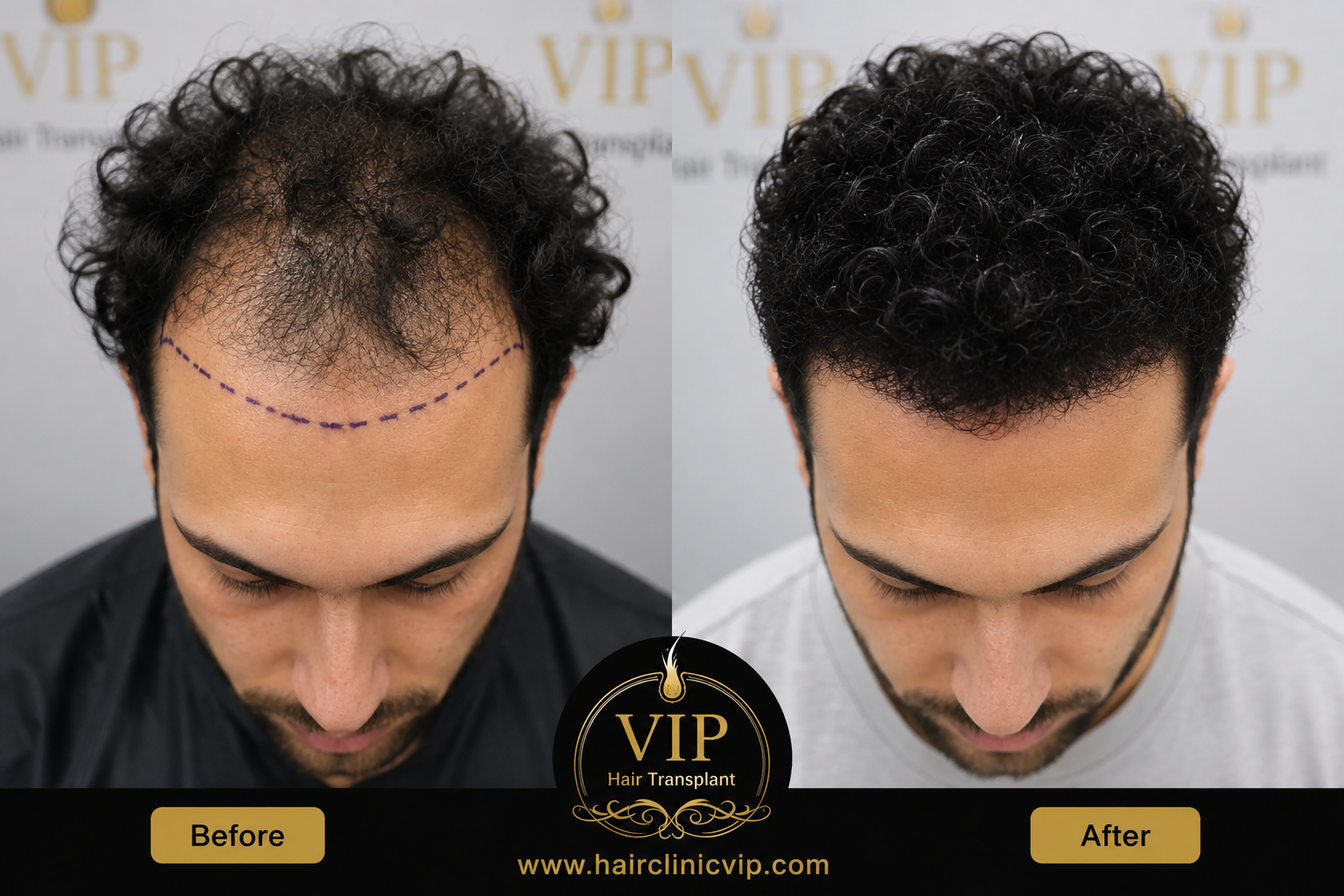
Hair Transplant for Curly and Wavy Hair: How Is It Different from Straight Hair?
How Is a Hair Transplant Performed for Curly Hair?
The basic goal of hair transplantation is the same for curly and
straight hair: healthy follicles are harvested from the donor area and
transplanted into thinning or bald areas.
The main difference is that the structure of curly hair and the
direction of the follicle beneath the scalp may make the harvesting process
more technically demanding.
In curly hair, the follicle may not follow a completely straight
path under the skin. Therefore, understanding the exact angle and direction of
hair growth is particularly important during graft extraction.
On the other hand, curly hair can offer an aesthetic advantage. Curly
and wavy hair generally provides greater volume and visual coverage, which
may help conceal the scalp more effectively.
Is Hair Transplantation More Difficult for Curly Hair?
Generally, hair transplantation for curly hair can be
technically more challenging, but this does not mean that curly-haired
individuals are unsuitable candidates.
Several factors are important:
1. Follicle Direction
With straight hair, the direction of the follicle is often easier
to predict. With very curly or tightly coiled hair, the follicle beneath the
skin may have a curved trajectory.
For this reason, the angle and depth of the extraction punch must
be carefully controlled.
2. Risk of Graft Damage
If the punch enters the skin without considering the follicle's
direction, the risk of damaging the graft may increase.
Therefore, the experience of the medical team performing
follicular extraction is particularly important.
3. Hairline Design
The hairline should be designed according to the person's age,
facial structure, degree of hair loss, and natural hair-growth pattern.
For curly hair, the direction and angle in which grafts are placed
can be especially important because an incorrect angle may become more
noticeable in the final result.
4. Visual Density
One of the major advantages of curly hair is its greater visual
volume. Therefore, the number of grafts required should not be determined
simply by counting hairs. Hair thickness, curl pattern, and natural density
should also be considered.
Will a Hair Transplant Look Natural on Curly Hair?
Yes. Curly hair itself does not prevent a natural-looking hair
transplant.
The naturalness of the result depends more on factors such as:
- Proper hairline design
- Appropriate graft selection
- Correct follicular extraction
- Preservation of graft quality
- Correct implantation angle and direction
- Appropriate density
- Experience of the medical team
- Scalp condition and the underlying cause of hair loss
A successful hair transplant is not simply about the number of
grafts. How the available donor hair is used and how future hair loss is
considered are also important.
What Is the Best Hair Transplant Method for Curly Hair?
One of the most common questions is: Is FUE or DHI better for
curly hair?
There is no single answer for everyone.
FUE generally refers to the method of extracting individual
follicular units, while DHI is primarily associated with the implantation technique.
Therefore, these terms are not always direct alternatives. In some treatment
plans, follicles may be harvested using an FUE technique and then implanted
using a DHI approach.
FUE Hair Transplant for Curly Hair
With FUE, individual follicular units are extracted from the donor
area.
Potential advantages include:
- Individual graft extraction
- Suitability for many hair-loss patterns
- No need for strip removal
- Precise planning for the use of donor grafts
However, the final outcome depends more on the quality of the
procedure and the patient's individual characteristics than on the name of the
technique alone.
DHI Hair Transplant for Curly Hair
In DHI, grafts are implanted into the recipient area using a
specialized implanter.
This technique may be used in selected cases, particularly when
precise implantation is required in limited or dense areas. However, it cannot
be said that DHI is the best option for every person with curly hair.
The choice between FUE, DHI, or another technique should be based
on the hair-loss pattern, donor-area quality, treatment goals, and medical
assessment.
DHI and Sapphire Hair Transplant at VIP Hair Transplant Clinic
According to the information published by VIP Hair Transplant
Clinic, the clinic offers hair transplantation using techniques such as DHI
and Sapphire, along with pre-treatment analysis and assessment.
For people with curly hair, the following factors should be
evaluated before selecting a technique:
1.
Degree of hair loss
2.
Cause of hair loss
3.
Donor-area density
4.
Hair-shaft thickness
5.
Degree of curl
6.
Scalp condition
7.
Number of grafts
required
8.
Facial structure and
appropriate hairline
9.
Possibility of
continued hair loss
Therefore, it is not recommended to choose a method based solely
on the name of the technique.
Advantages of Hair Transplantation for Curly Hair
Curly hair has several potential advantages despite its technical
challenges.
Better Scalp Coverage
The natural curl of the hair can create greater volume and reduce
the visibility of the scalp.
Fuller Appearance
Even when the actual number of hairs is the same, curly hair can
create greater visual density than completely straight hair.
Natural-Looking Results
When grafts are implanted at appropriate angles and directions,
the natural texture of curly hair can help conceal thinning areas.
Efficient Use of the Donor Area
In some individuals, the greater visual coverage provided by curly
hair may allow an aesthetically satisfactory result with fewer grafts than
initially expected. However, the exact number of required grafts can only be
determined after evaluating the donor and recipient areas.
Can Very Curly Hair Be Transplanted?
In many cases, yes.
However, the more tightly curled the hair is, the more important
the extraction technique becomes. With very curly hair, the physician should
pay particular attention to the direction of the follicle beneath the scalp.
Therefore, anyone considering a hair transplant for very curly
hair should have their donor area and follicular condition carefully
assessed before making a decision.
Will Transplanted Hair Remain Curly?
If curly follicles are harvested from the donor area, they
generally retain the characteristics of those follicles.
Therefore, when follicles with a natural curl pattern are
transplanted, the newly growing hair is generally expected to maintain similar characteristics.
However, the appearance of the hair may change during the early
stages of growth, and sufficient time should be allowed before evaluating the
final texture and appearance.
Post-Transplant Care for Curly Hair
Post-operative care is important regardless of hair type.
During the first days and weeks, patients should avoid scratching
or manipulating the recipient area and follow their physician's instructions
regarding washing and scalp care.
For people with curly hair, an important point is not to rush
into styling newly transplanted hair.
Using fine-tooth combs, pulling the hair, applying heavy styling
products, or frequently touching the scalp too soon may not be appropriate for
newly transplanted grafts.
The timing for normal washing, hair products, and returning to the
previous hair-care routine should be determined according to the physician's
instructions.
How Long Does Hair Take to Grow After a Transplant?
Hair growth after transplantation is not immediate.
In many patients, transplanted hairs enter a resting phase before
gradual growth begins. The exact timeline varies from person to person.
Therefore, the final result should not be judged only a few weeks
after the procedure.
Who Is a Good Candidate for Hair Transplantation?
A suitable candidate should first be evaluated for the cause of
hair loss and the condition of the donor area.
In general, having an adequate donor supply, a suitable recipient
area, and a hair-loss pattern that can be reasonably planned are important
factors.
In some patients, the cause of hair loss should first be diagnosed
and managed before transplantation is considered.
For this reason, pre-transplant consultation is an
important part of the treatment process.
Why Is Choosing the Right Doctor Important for Curly Hair
Transplantation?
In hair transplantation, choosing the technique is only part of
the process.
For curly and tightly curled hair, experience in proper graft
extraction is particularly important because the follicle's path beneath the
skin may differ from the visible direction of the hair shaft.
Hairline design must also be coordinated with the natural
direction and texture of the hair.
When choosing a clinic, do not focus only on claims such as “a
high number of grafts” or “the latest technique.” Also consider:
- Which doctor performs the procedure?
- How is the donor area evaluated?
- How is the hairline designed?
- How is the extraction method selected?
- Are authentic and verifiable before-and-after cases
available?
- What follow-up program is provided after the procedure?
- Is the cause of hair loss evaluated before transplantation?
Hair Transplantation for Curly Hair at VIP Hair Transplant Clinic
VIP Hair Transplant Clinic offers hair transplantation
and consultation services and presents techniques such as DHI and Sapphire as
part of its hair-transplant services.
For someone with curly or wavy hair, the most important
consideration is that the treatment plan should be personalized. Two people
with curly hair may require completely different treatment plans because of
differences in donor density, hair thickness, degree of baldness, and hair-loss
pattern.
Therefore, the donor area and recipient area should ideally be
assessed before deciding on the number of grafts or selecting a specific
technique.
Frequently Asked Questions About Hair Transplantation for Curly
Hair
Is curly hair suitable for a hair transplant?
Yes. Curly hair alone is not a reason to avoid hair
transplantation. However, follicle direction and extraction technique may
require additional attention.
Is a curly hair transplant more painful?
Pain depends on factors such as the procedure, individual
sensitivity, anesthesia, and post-operative care. Curliness itself does not
necessarily mean that the procedure will be more painful.
Is FUE or DHI better for curly hair?
There is no universally best technique. FUE primarily refers to
follicular extraction, while DHI refers mainly to the implantation approach.
The appropriate option should be selected based on the individual's condition.
Will transplanted hair remain curly?
Transplanted follicles generally retain their natural
characteristics. Therefore, when follicles are harvested from a curly-haired
donor area, the new hair is generally expected to retain similar
characteristics.
Does curly hair look denser after transplantation?
Because curly hair naturally has greater volume and texture, it
can provide better visual coverage. However, actual density and final results
depend on the number and quality of grafts and other individual factors.
How many grafts are needed for curly hair?
There is no fixed number. The required number depends on the
extent of baldness, desired density, hair characteristics, and donor capacity.
Does VIP Hair Transplant Clinic perform hair transplants for curly
hair?
VIP Hair Transplant Clinic offers hair transplantation and
introduces techniques including DHI and Sapphire. The appropriate method for
curly hair should be determined following an individual medical assessment.
Conclusion
Hair transplantation for curly and wavy hair is
possible and, with proper planning, can provide a natural-looking result with
good visual coverage.
The main differences between curly and straight hair involve
follicular structure, the possible curvature of follicles beneath the skin,
graft-extraction technique, and the importance of implantation angle and
direction.
At the same time, curly hair can offer an important advantage
because its natural volume and curl pattern can provide better visual coverage
of the scalp.
Ultimately, the choice between FUE, DHI, or another technique
should not be based solely on advertising or the name of a procedure. Donor
density, the cause and degree of hair loss, hair thickness, curl pattern, and
hairline design should all be considered together.
For people considering a hair transplant in Dubai , VIP Hair
Transplant Clinic offers hair transplantation and pre-treatment consultation
services.
Request Consultation
There are many books written about the past, present, and future that require extensive knowledge from specialists to better understand the software.